Or listen on:





A dramatic and mysterious decline of an iconic bird of prey piqued the curiosity of conservation experts all over the world. So, they got to work.
In this episode, we track this speedy bird’s race to escape extinction and the decades-long collaborative effort to course correct their dramatic collapse. From policy change to captive breeding, these combined efforts created one of the greatest conservation success stories in history.
“I think back to the first peregrine falcon that ever came to Salthaven, and my first thought was, ‘This is a real peregrine falcon!’ They're absolutely gorgeous birds. There's an intelligence about them that is pretty amazing. You can see it in their eyes, and being up close with them is...almost a spiritual experience.” –Brian Salt, founder of Salthaven Wildlife Rehabilitation and Education Centre
ZIYA TONG: In 1939, a Swiss chemist named Paul Herman Müller discovered that a chemical compound called DDT was incredibly effective at killing insects. Müller made his discovery just as World War II was ramping up. Both the British and American armies were concerned about insect-borne diseases like typhus and malaria. By 1942, DDT was on military supply lists, and it was being sprayed on the troops—and basically everyone else. After the war ended in 1945, DDT became available as a household and agricultural insecticide. It was a miracle product for farmers and housewives, but there was one problem. Farmers were spraying a lot of DDT on their crops. And small insects would eat those crops and die, just as intended. But then, small rodents and birds would eat those insects, and end up with even more DDT in their systems. And then, those small animals would get eaten by predators. Including the peregrine falcon.
ZIYA TONG: I’m Ziya Tong, a science broadcaster and explorer of our beautiful planet. I’ve spent my career bringing nature to people and people to nature. On this podcast, we’re meeting the incredible species that call Canada home, and the people working to protect them. From WWF-Canada, you’re listening to This Is Wild.
ZIYA TONG: Growing up, most of us were taught that the dinosaurs went extinct 66 million years ago. But that’s not quite right—there are dinosaurs living among us right now! Okay, so not exactly, but birds are descended from dinosaurs, and there are types of birds that are called raptors. You probably know them as birds of prey. Raptors are birds that eat meat. They’re incredible hunters, with super strong talons and sharp eyesight to help them spot prey from far away. Most importantly, they are fast. And the speediest among them is the peregrine falcon.
BRIAN SALT: The fastest ever recorded speed of a peregrine falcon was 242 miles per hour. That's 389 kilometers an hour, so that's pretty fast.
ZIYA TONG: This is Brian Salt. He’s the founder of Salthaven Wildlife Rehabilitation and Education Centre in Strathroy, Ontario. Brian has been helping injured animals for decades. And in that time, he’s had the opportunity to treat his fair share of peregrine falcons.
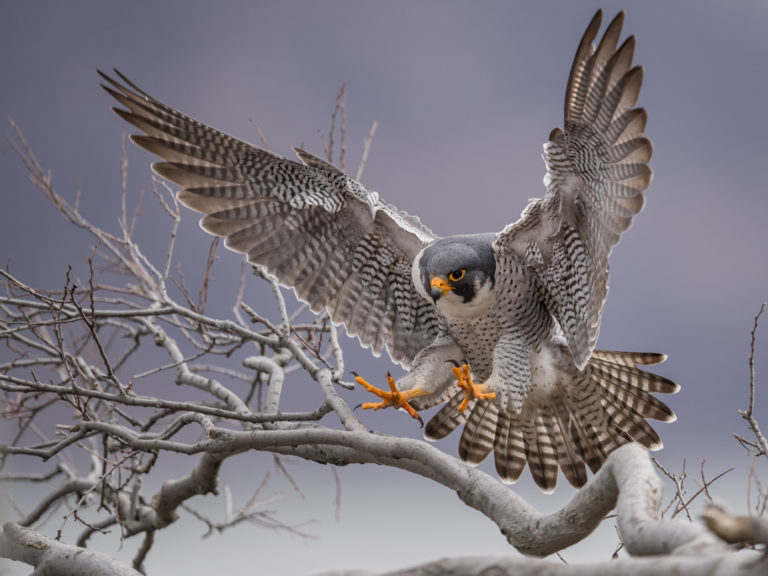
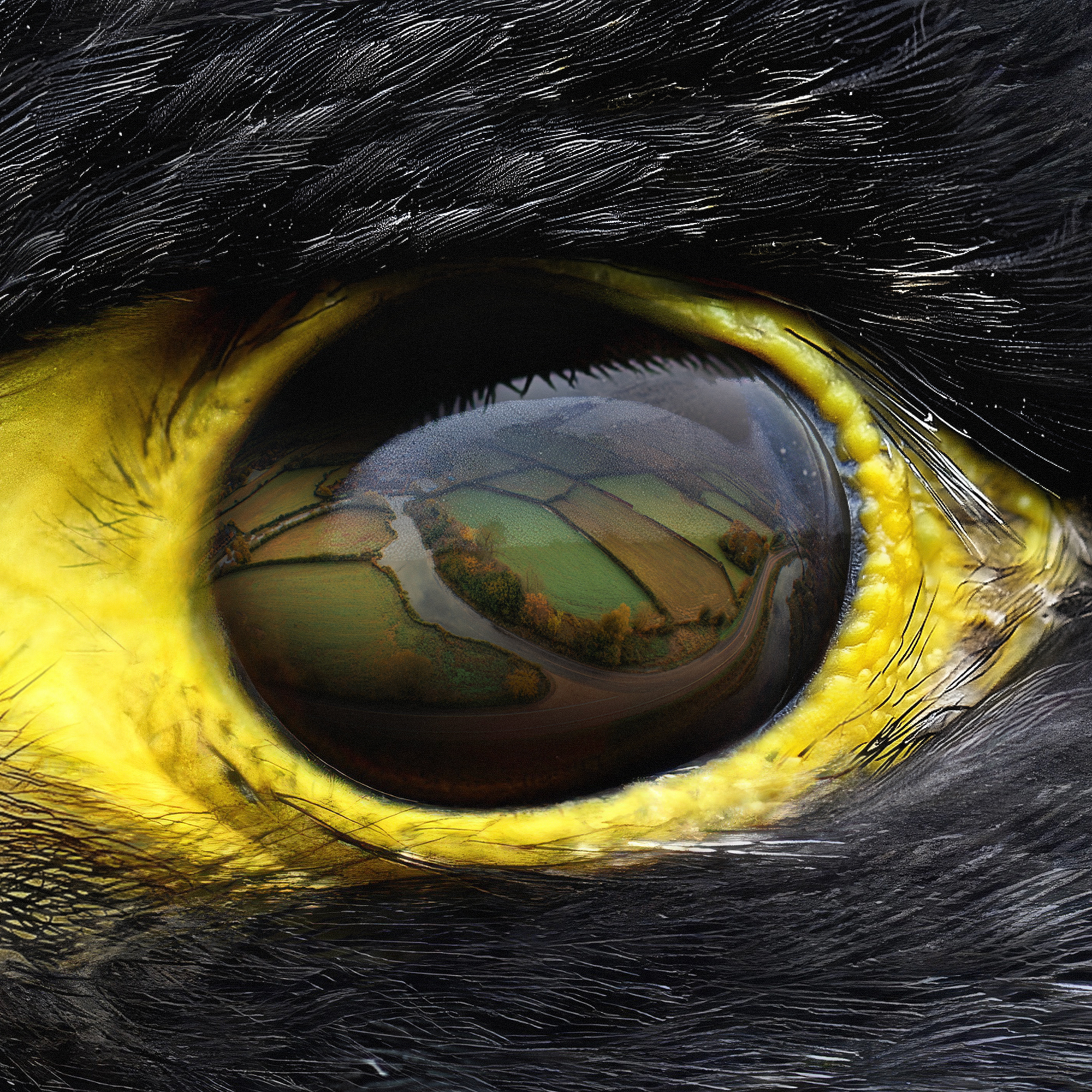
BRIAN SALT: I think back to the first peregrine falcon that ever came in to Salthaven. And my first thought was, this is a real peregrine falcon! You know, we've never had one of these before. And they're absolutely gorgeous birds. Their eyes are penetrating, their face, and that black hood that they have with those teardrop marks under the eyes. There's an intelligence about them that is pretty amazing actually. You can see it in their eyes and being up close with them is, yeah, it's almost a spiritual experience.
ZIYA TONG: According to Brian, peregrines aren’t quite like other raptors. In his experience, they can actually be quite gentle.
BRIAN SALT: You know, we communicate through words and vocalizations, but these animals, for the most part, communicate with body language. And the body language on a bald eagle oftentimes can be so subtle, you don't even know what they're thinking or what they are going to do next. Whereas with a peregrine falcon, they're somewhat more, I call it amiable. You can read them a little easier. And that helps to keep the stress off of them and helps you from being injured in the process of working with them.
ZIYA TONG: But that doesn’t take away from those fierce hunting skills. In fact, peregrine falcons even have a signature hunting move. It’s called a stoop. Picture this: a large bird, about the same size as a crow, with a sharp, curved yellow beak, flies high up into the air—so high you can barely see it. It circles around a few times, and then, with no warning…it dives.
BRIAN SALT: So they'll go into a stoop and they'll dive down and they gain speed by tucking their wings in, and just the shape of the bird allows the airflow to go over them in such a way that they can actually dive through gravity.
ZIYA TONG: As the bird dives, it tucks its head to one side and draws one wing up to be as narrow—and aerodynamic—as possible.
BRIAN SALT: Like a person jumping off, you know, doing skydiving, their terminal velocity would be about 120 miles an hour. And of course, a bird of prey is so much faster than that, especially the falcons.
ZIYA TONG: It keeps flying down, down, down. And just as it seems like it’s going to hit the ground, it pulls out of the dive—and snatches its prey.
The little guy never saw it coming.
BRIAN SALT: One of the things too with these birds is that they're pulling incredible G-forces when they're coming out of a dive. So you know, as a human in an airplane, a jet fighter pilot, for instance, can pull about 10 Gs before he starts to black out. And that means your body weighs 10 times what it normally does. And so, these birds, the way they're constructed, their bone structure is just amazing that it can withstand that type of a G-force. It's only momentarily, but even that momentary G-force on a human would just crush you.
ZIYA TONG: Peregrines mostly eat small birds, but they also enjoy fish and rodents. Over the last few decades, they’ve become particularly interested in one very specific delicacy: the common pigeon.
EMILY GILES: Pigeons are one of their top prey sources in an urban environment. So they actually do a great job at helping to control those pigeon populations. So that's one of the key things that's great about peregrine falcons.
ZIYA TONG: This is Emily Giles. She works at WWF-Canada, where she manages all kinds of national projects related to protecting our wildlife and environment. Emily actually got her start in this field by volunteering with Brian’s organization.
EMILY GILES: I first got interested in conservation work when I was in high school and I volunteered at Salthaven and there, I got to work hands-on with animals and with wildlife species and I just fell in love with working with animals and wanted to do more to protect and help them.
ZIYA TONG: In those early years of her conservation career, Emily also volunteered with the Canadian Peregrine Foundation.
EMILY GILES: Part of that job was to clean the cages and feed peregrine falcons. And they really are a beautiful, charismatic bird. And to see them up close is pretty amazing.
ZIYA TONG: Later, when Emily moved to downtown Toronto, she was delighted to find that she could still spot a peregrine or two in her everyday life.
EMILY GILES: So often in the spring, the peregrines are nesting behind the sign of the Rogers Centre, behind the big letters that spell out "Rogers Centre," there's often a pair of peregrines nesting there. And if you don't see them there, you can look up, like way way way up, at the CN Tower, and often see them flying around the tower. If you see a bird that you're like, oh, is that a bird or is that just like a little tiny speck in the sky? And then you watch and you see it kind of do that free fall, then yeah, that's definitely a peregrine.
ZIYA TONG: In the natural world, peregrines like to nest on tall cliffsides, where they can keep an eye out for predators with a literal bird’s eye view. But as dense cities with tall buildings have become more common, peregrines have adapted. They nest on skyscraper windowsills and, as Emily said, they keep the pigeon population in check. But peregrine falcons haven’t always been so commonplace. Just a few decades ago, it seemed like they were going to disappear entirely, in large part because of that pesky pesticide: DDT.
EMILY GILES: DDT is a pesticide that was very widely used in agriculture in Canada and across North America, beginning in the 40s and continuing into the 50s and 60s. And it turned out that DDT was a huge threat to many bird species, including peregrine falcons.
ZIYA TONG: DDT also had a huge impact on the populations of bald eagles, ospreys, and even common songbirds like robins. This all came down to a process called biomagnification.
EMILY GILES: So if you think about something like an earthworm, it might not have that much DDT present in its body, but if a robin in turn eats 20 earthworms in a day, it's going to accumulate a lot of DDT from all of those worms. And then if another bird, say the peregrine falcon, eats five robins in a day, then it in turn is going to accumulate even more DDT. So it really does accumulate as it moves up the food chain.
ZIYA TONG: Before World War II, there were about 4000 nesting pairs of peregrine falcons in North America. By 1975, that number had plummeted to just 324. The story of the global decline of the peregrine falcon started to gain public attention in the early 1960s. And the crisis soon went from scientific studies to front page news.
GORDON COURT: It was announced that the last peregrine pair that was to nest in the Prairie biome of Canada, that one of the adults didn't come back. I think that was probably about the early 1970s.
ZIYA TONG: This is Gordon Court. He was around 10 years old when he saw an article in the paper that changed his life.
GORDON COURT: The male had come back but the female didn't and it was front page news of the Edmonton Journal and I realized that, you know, sense of doom we all felt that we were going to lose these things and, you, know, I had no perspective on the populations in other parts of the world. I just knew the ones that once occurred in Alberta were now gone and that's really set the trajectory for me to go on and study not only birds but wildlife toxicology and that end of it.
ZIYA TONG: Today, Gordon is a wildlife status biologist for the Government of Alberta. But back in the ‘70s, he was just a kid who loved birds.
GORDON COURT: If my mom and dad dropped me off at the zoo or something, they could find me all day at the birds of prey, just sitting there, ignoring everything else.
ZIYA TONG: Around the time that Gordon was watching those birds at the zoo, scientists were puzzling over a peregrine decline that had been going on for more than a decade.
GORDON COURT: It was actually Derek Radcliffe, a very fine scientist from Britain, who was hired ironically enough to determine whether or not peregrines were becoming overabundant in Britain.
ZIYA TONG: Radcliffe was hired by the British government in response to complaints from the pigeon racing community.
GORDON COURT: They said that our hobby is really being affected by the abundance of this particular bird and we'd like something done about it. And they hired Radcliffe to go out and look to see whether or not they were indeed overrunning the country and instead of finding them overrunning the country, he didn't find them at all.
ZIYA TONG: Radcliffe continued his research. He realized that peregrine falcons weren’t just dying out of nowhere. They seemed fine. They were even breeding! Eventually, he figured out that it wasn’t the falcons themselves that were the problem. It was the eggs.
GORDON COURT: We started to see thinner eggs, you know, even in the late ‘40s in Britain, and all across Eastern North America, especially east of the Mississippi in the States.
ZIYA TONG: After DDT enters the body, it turns into a different chemical called DDE. And DDE can trick a bird’s body into thinking it has more calcium than it actually does. Calcium is crucial for developing strong eggshells. More DDE means less calcium. And less calcium means weaker eggs.
GORDON COURT: If you have thinning that goes beyond 17% percent of normal you start to get breaks, cracks, and sometimes they collapse completely. A small crack can allow moisture loss, it's too high, and the bird just sticks to the inside of the shell and dies. Sometimes the embryos die outright and other times it's just the weight of the female peregrine which is probably a thousand grams and she's sitting on four eggs and if they try and nest in gravel that's got some pointy little rocks in it there, you're going to pop a hole in there and you're going to have a problem and eventually the eggshell will be compromised enough that it breaks.
ZIYA TONG: Peregrines only lay around 3 or 4 eggs per year. And because of those risky hunting strategies we talked about earlier, they also have a tendency to die young. Over half of peregrine chicks don’t make it past their first year. All of these factors together meant that without help, peregrines were on a fast track towards extinction. But thankfully, help was on the way. In 1973, a biologist named Richard Fyfe and other members of the Canadian Wildlife Service took over a former military base in Wainwright, Alberta.
GORDON COURT: They had a quiet piece of land and they started with an ADCO trailer and as many peregrines as they could grab, either from falconers who donated them or some of the last pairs that were on nest sites in northern Alberta. And they set up a small population of birds in the hopes of breeding them. And they really had not been bred in captivity before.
ZIYA TONG: The initiative was successful. Through the captive breeding program, happy, healthy peregrine chicks were hatching in Alberta for the first time in years. By that time, Gordon was in high school. In his free time, he would ride his bike down to the lab in Edmonton where they were releasing the peregrines. The scientists started to notice.
GORDON COURT: And I think I was in a chemistry class in high school and my mom had me pulled out a class and said, a man named Richard Fyfe just asked if you wanted a job for the summer. So it was kind of like a kid who was interested in marine biology being phoned up by Jacques Cousteau and asked if he wanted to go for a summer job, so it was pretty good.
ZIYA TONG: Over the course of the next few years, Gordon continued to work his dream job helping peregrines get back into the wild. He learned about peregrine breeding habits, how to incubate healthy eggs, and finally, how to introduce babies that were born in captivity into their natural habitat. One day, in 1977, Gordon was out on his daily survey of nearby peregrine nesting sites when he saw something that stopped him in his tracks. He ran back to the lab to tell his colleague.
GORDON COURT: I mentioned to her that I thought I'd saw the female we were watching had a black band on her, which was basically an indication that it had come from captivity. And she says, I think you're right. And so when Richard Fyfe heard about this, he was on the next plane up and we put him in a little blind and this telescope and he read the band and it actually turned out to be a bird that had been fostered into a wild nest two years before and was breeding for her first time. But she turned out to be the first captive-raised peregrine anywhere in the world to come back and breed in a population which was a real feather in the cap of the Canadian program for sure.
ZIYA TONG: It wasn’t just captive breeding programs that brought peregrine falcons back from the brink. While Gordon and other biologists around the world were working on hatching more baby falcons, environmentalists and policymakers were trying to ban DDT. Here’s Emily Giles from WWF-Canada again.
EMILY GILES: So the good news is that DDT began to be heavily phased out in Canada in the 1970s. And then it was completely banned in North America by 1990 and populations of birds recovered really quickly after the ban of DDT.
ZIYA TONG: At the same time, the Canadian government was waking up to the idea that certain species needed federal protection from environmental threats.
EMILY GILES: So COSEWIC is a bit of a mouthful but it stands for the Committee on the Status of Endangered Wildlife in Canada and it was established in 1977 in order to provide independent scientific assessment of how species were faring. So peregrine falcons were one of the first species that were assessed by COSEWIC and at that time, in the late ‘70s, they were designated as endangered.
ZIYA TONG: Between these new federal protections, the DDT ban, and the captive breeding programs, peregrine falcons and other birds of prey quickly started to recover. By the late 1990s, there were more than 7000 breeding pairs of peregrine falcons across Canada. And in 2017, COSEWIC declared that two of the three subspecies of peregrine falcon are no longer at risk. The story of the global peregrine falcon recovery is a hopeful one. Unfortunately, it’s also unique.
EMILY GILES: It's one of the best stories that we have as conservationists to point to of a species that we have successfully recovered. And unfortunately, there aren't more stories like this that we can point to where we very clearly knew what the threat was and were able to remove that threat. Typically, it's much more complicated than that.
ZIYA TONG: Most of the time, when a species is threatened, there isn’t just one solution. Between pollution, habitat loss, and industrial development (not to mention climate change), it can all start to feel a little overwhelming. From Emily’s perspective, that’s exactly what makes the peregrine story so valuable.
EMILY GILES: We need more stories like the peregrine falcon success story to point to. Just so that we can be reminded that when we do take action to help a species at risk, we can be successful, but often it requires a policy change or a major shift in how we operate in order to help the species. And we also need to be reminded that humans are not separate and apart from nature. We are very much a part of it. And often what affects wildlife affects us as well, so it's for that reason that birds are often considered the canary in the coal mine and a really good indicator species because they can show us when something is out of balance and when something in the environment needs to be addressed. And unfortunately, it was the peregrine falcon that, you know, was affected by this, but thankfully we were able to listen to what was going on and pay attention and take the appropriate steps to to ban DDT and thankfully save the peregrine falcon.
ZIYA TONG: It’s easy to feel powerless, but history shows us that noticing the problem, and doing something about it, can create significant change. For wildlife rehabilitator Brian Salt, that philosophy motivates him every day.
BRIAN SALT: A lot of people think, well, what difference can I make? Collectively, we can make a whole lot of difference. You know, there's that old story of the gentleman walking on the beach and off in the distance he sees a young boy throwing things in the water. And as he made his way closer to him, he calls out to the boy and says, young man, what are you doing? And the boy said, well, tide's gone out, and all these starfish are washed up on the shore. Unless they get back in the water, they're all going to die. And with that, the gentleman looked around and said, young man, there are hundreds of starfish on this beach. You really think you're going to make a difference? And with that, the little boy stooped down, picked up another starfish and threw it in the water, and then he looked the gentleman right in the eye and he said, well, now it made a difference to that one, didn't it? And I think, you know, on a spiritual level or whatever you want to call it, you can feel the difference and that difference sometimes is only within you. You know, so we save a peregrine falcon, okay, well, that's wonderful, but you take that with you, and I think that penetrates you on a deeper level that makes you a little bit different person. So the closer we can get to nature, and the kinder we are to nature in looking ahead to see what we can do to live harmoniously with it, I think it makes a big, big difference on who we are as people.
ZIYA TONG: Thanks for joining us today on This Is Wild! I’m your host, Ziya Tong. To learn more about the amazing recovery story of the peregrine falcon, you can check out WWF.ca/thisiswild. If you enjoyed this episode, please leave us a review on your favourite podcast app, and don’t forget to share this show with your friends! This Is Wild is created by WWF-Canada and Antica Productions. Our executive producers are Geoff Siskind, Laura Regehr, and Stuart Coxe. This episode was written and produced by Emily Morantz. Our production team at WWF-Canada is Joshua Ostroff, Erin Saunders, and Tina Knezevic. Nicole MacAdam is WWF's VP of Comms. Mixing and sound design by Philip Wilson.

Ziya Tong is an award-winning science journalist, known for making complex ideas accessible and engaging. She hosted Discovery Channel’s flagship show Daily Planet and has appeared on PBS, CBC and CTV. A passionate advocate for the planet, Ziya serves on the board of WWF-International, is the author of The Reality Bubble, about environmental blind spots, and co-director of the documentary Plastic People: The Hidden Crisis of Microplastics.